What Is a Market Correction?
What is a market correction and why does it happen? This beginner-friendly guide explains stock market pullbacks using simple real-world examples anyone can understand.
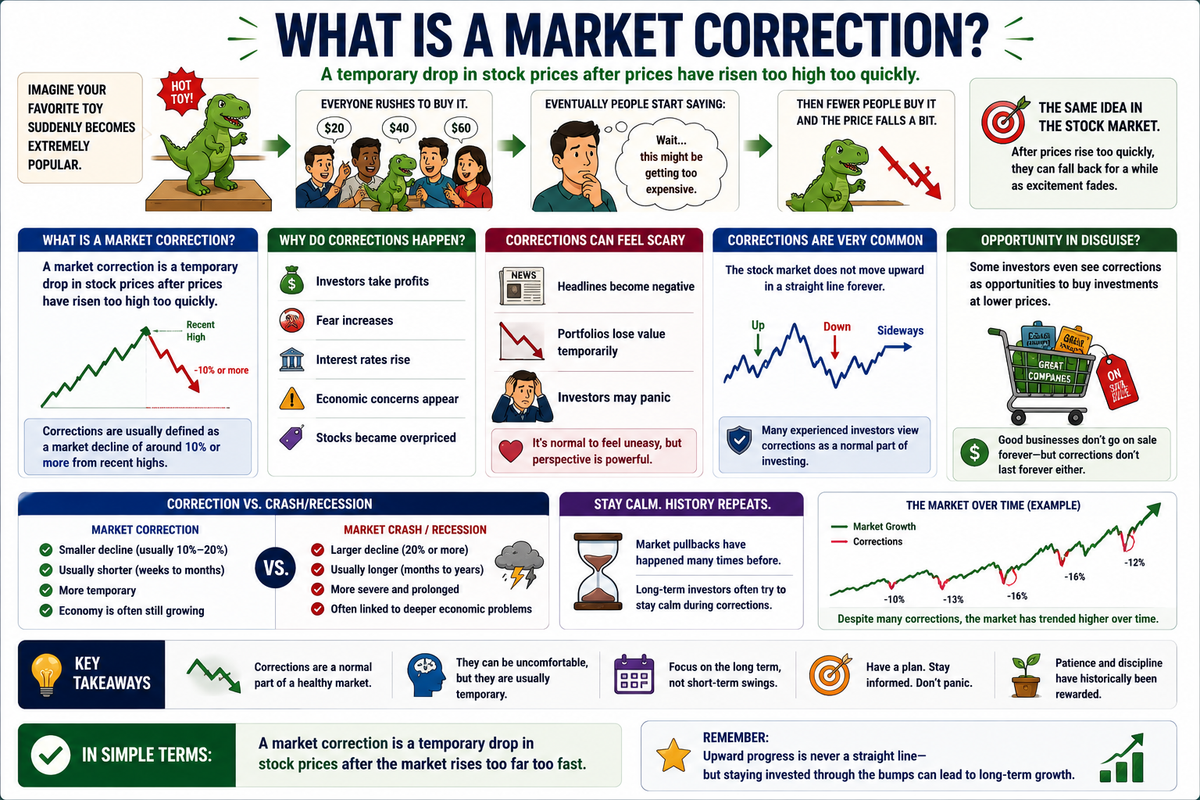
Imagine your favorite toy suddenly becomes extremely popular.
Everyone rushes to buy it.
The price keeps climbing:
- $20
- $40
- $60
Eventually people start saying:
“Wait… this might be getting too expensive.”
Then fewer people buy it and the price falls a bit.
That is similar to what can happen in the stock market.
A market correction is:
A temporary drop in stock prices after prices have risen too high too quickly.
Corrections are usually defined as:
- a market decline of around 10% or more from recent highs
Corrections can happen because:
- investors take profits
- fear increases
- interest rates rise
- economic concerns appear
- stocks became overpriced
Corrections can feel scary because:
- headlines become negative
- portfolios lose value temporarily
- investors may panic
But corrections are actually very common.
The stock market does not move upward in a straight line forever.
It naturally moves:
- up
- down
- sideways
Many experienced investors view corrections as:
A normal part of investing.
Some investors even see corrections as opportunities to buy investments at lower prices.
A correction is different from a crash or recession.
Corrections are usually:
- smaller
- shorter
- more temporary
While larger market declines may involve deeper economic problems.
Long-term investors often try to stay calm during corrections because:
Market pullbacks have historically happened many times before.
In simple terms:
A market correction is a temporary drop in stock prices after the market rises too far too fast.