FDIC vs SIPC
What is the difference between FDIC and SIPC protection? This beginner-friendly guide explains how banks and brokerage accounts are protected using simple real-world examples anyone can understand.
Imagine you keep money in two different places.
The first place is:
- a bank savings account
The second place is:
- an investing account holding stocks and ETFs
Both places protect customers differently.
That is where FDIC and SIPC come in.
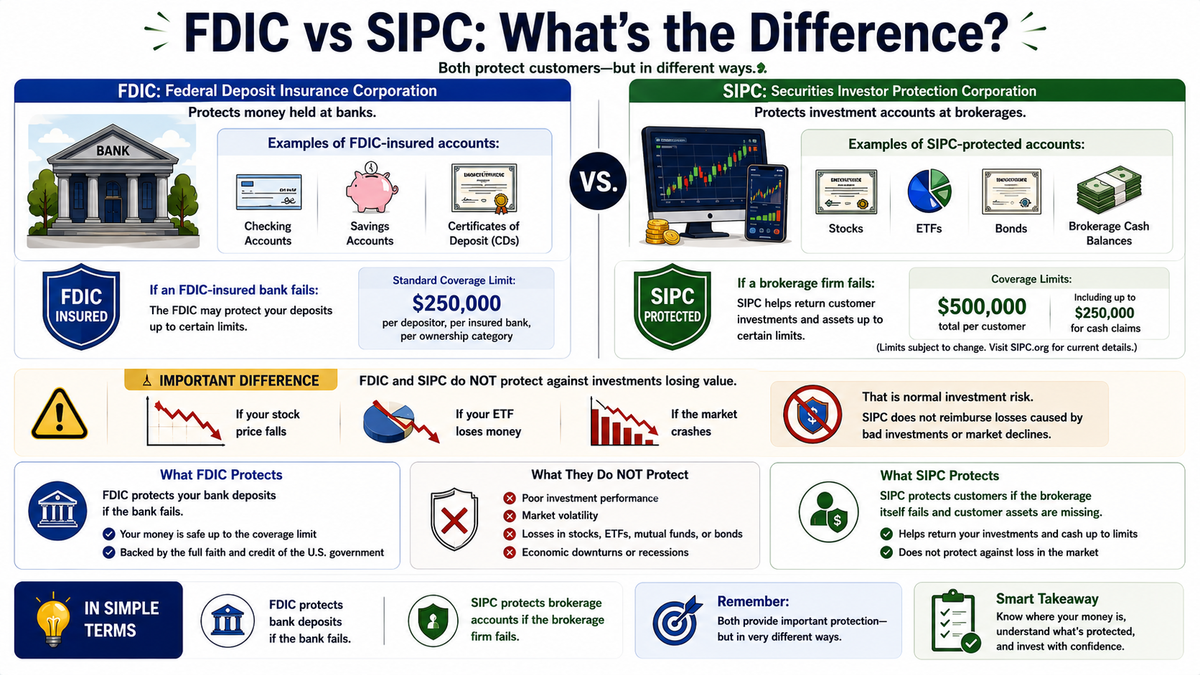
FDIC stands for:
Federal Deposit Insurance Corporation
The FDIC protects money held at banks.
Examples include:
- checking accounts
- savings accounts
- certificates of deposit (CDs)
If an FDIC-insured bank fails:
The FDIC may protect your deposits up to certain limits.
SIPC stands for:
Securities Investor Protection Corporation
SIPC protects investment accounts at brokerages.
Examples include:
- stocks
- ETFs
- bonds
- brokerage cash balances
If a brokerage firm fails:
SIPC helps return customer investments and assets up to certain limits.
But there is a very important difference.
FDIC and SIPC do NOT protect against investments losing value.
For example:
- if your stock price falls
- if your ETF loses money
- if the market crashes
That is normal investment risk.
SIPC does not reimburse losses caused by bad investments or market declines.
Instead:
SIPC mainly protects customers if the brokerage itself fails and customer assets are missing.
Meanwhile FDIC protects bank deposits if the bank fails.
In simple terms:
FDIC protects bank deposits, while SIPC protects brokerage accounts if the financial institution fails.